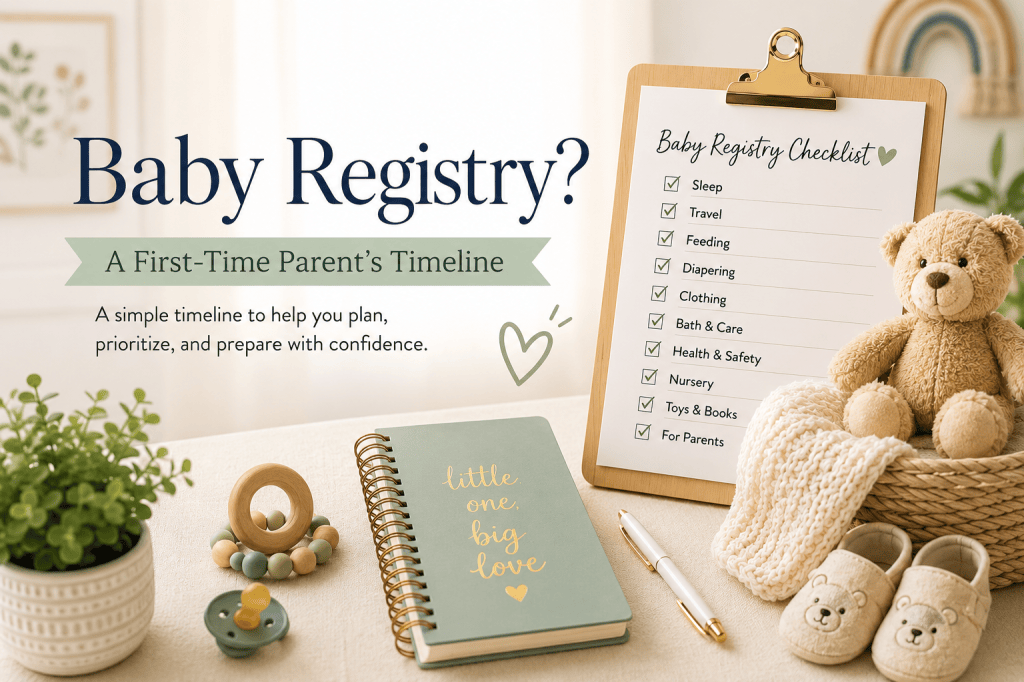
Finding out you’re expecting comes with a long list of things to think about—and somewhere between choosing baby names and researching car seats, you may start wondering:
When should I actually start my baby registry?
The good news is that there’s no official week when you have to begin.
For many first-time parents, starting a registry sometime during the late first trimester or early second trimester works well. It gives you plenty of time to research products, make changes, and build your list gradually instead of trying to choose everything at once.
You also don’t have to make your registry public immediately. You can start privately, add and remove products as you learn more, and share it when you’re ready.
Here’s a simple timeline to help you decide what to do—and when.
When Is the Best Time to Start a Baby Registry?
A practical time to begin is around 12–16 weeks of pregnancy.
At this point, you still have plenty of time before your due date, so there’s no pressure to finish everything immediately.
Think of your registry as a work in progress.
Start with the products you already know you’ll need, then gradually research bigger decisions such as:
- Car seats
- Strollers
- Cribs and bassinets
- Baby monitors
- Feeding supplies
- Diapering essentials
- Baby carriers
You can continue editing your registry throughout your pregnancy.
ToBeBaby Tip: Start your registry privately. There’s no reason friends and family need to see it while you’re still comparing products.
Common Mistake to Avoid: Waiting until shortly before your baby shower and then trying to research dozens of products in one weekend.
First Trimester: Research, Don’t Rush
Weeks 1–13
You don’t need to build a complete registry during your first trimester.
If you’re excited to start, however, there’s nothing wrong with creating an account and saving ideas.
This is a good time to research the bigger picture:
- Which registry platform you want to use
- What your home has room for
- Your approximate baby-gear budget
- Whether you want a travel system or separate stroller and car seat
- Where your baby will sleep
- What products you may be able to borrow or receive secondhand
You may also want to create a private list of products you see recommended frequently.
You don’t have to decide whether every product belongs on your final registry yet.
ToBeBaby Tip: Use the first trimester as your research phase. Save products that interest you and make final decisions later.
Common Mistake to Avoid: Buying or registering for products simply because they’re trending before determining whether they fit your family’s lifestyle.
Early Second Trimester: Start Building Your Registry
Around Weeks 14–20
This is a great time to begin building the registry more seriously.
Start with the major categories rather than individual products.
For example:
Sleep
- Crib or bassinet
- Firm mattress appropriate for the sleep product
- Fitted sheets
- Appropriate sleep clothing
Travel
- Infant or convertible car seat
- Stroller
- Baby carrier
- Diaper bag
Feeding
- A small selection of bottles
- Burp cloths
- Bibs
- Feeding supplies appropriate for your plans
Diapering
- Diapers
- Wipes
- Changing pad
- Diaper cream
Clothing
- Bodysuits
- Sleepers
- Socks
- Seasonal layers
Bath & Care
- Baby bathtub
- Gentle skincare basics
- Towels and washcloths
- Thermometer
- Grooming basics
At this stage, don’t worry about having the perfect registry.
You’re simply creating the foundation.
ToBeBaby Tip: Add products by category so you can easily see what’s missing instead of randomly adding items as you discover them.
Common Mistake to Avoid: Registering for too many versions of the same product before you know what you’ll actually use.
Mid-Second Trimester: Research the Big-Ticket Items
Around Weeks 18–24
Now is a good time to narrow down your larger purchases.
These are the products worth spending extra time researching because you’ll likely use them frequently.
Car Seat
Consider:
- Your vehicle
- Installation method
- Size and weight
- Ease of use
- Whether you want an infant seat or convertible seat
- Compatibility with your stroller, if applicable
Whatever model you choose, follow the manufacturer’s instructions and current child-passenger safety guidance when installing and using it.
Stroller
Think about where you’ll actually use it.
Do you mostly need something for:
- Neighborhood walks?
- Shopping?
- Travel?
- Uneven terrain?
- A growing family?
The best stroller isn’t necessarily the most expensive one. It’s the one that fits your lifestyle.
Crib or Bassinet
Choose products intended for infant sleep that meet applicable safety requirements.
For infant sleep, current CPSC guidance recommends a firm, flat sleep surface in an appropriate crib, bassinet, play yard, or bedside sleeper. Keep the sleep space bare except for a fitted sheet, and place your baby on their back for sleep. (U.S. Consumer Product Safety Commission)
ToBeBaby Tip: Spend your research time on products that affect safety or that you’ll use every day. You don’t need to spend three hours comparing burp cloths.
Common Mistake to Avoid: Choosing expensive baby gear based primarily on appearance instead of checking whether it works with your home, vehicle, and lifestyle.
Before Your Baby Shower: Finish the Main Registry
If you’re having a baby shower, try to have the majority of your registry finished before invitations are sent or before guests are likely to begin shopping.
You don’t need every last detail finalized.
But you should have a good range of:
- Lower-cost essentials
- Mid-priced products
- A few larger items
- Everyday supplies
Having products at different price points gives guests flexibility.
You can still make changes after sharing the registry.
ToBeBaby Tip: Review the registry as if you were a guest. Is there a reasonable selection of gifts at different prices?
Common Mistake to Avoid: Filling the registry mostly with expensive products and leaving guests with very few affordable choices.
Third Trimester: Fill the Gaps
Around Weeks 28–34
By the third trimester, your registry should be mostly complete.
Now you can look at what has already been purchased and identify what’s still missing.
Prioritize things you’ll need immediately after your baby arrives.
These may include:
- An appropriate infant sleep space
- Car seat
- Diapers and wipes
- Basic clothing
- Feeding supplies
- Changing supplies
- Bath and grooming basics
This is also a good time to organize products you’ve already received and avoid accidentally purchasing duplicates.
ToBeBaby Tip: Separate your remaining list into Need Before Baby Arrives and Can Buy Later.
That makes the final weeks much less overwhelming.
Around Weeks 34–36: Make Sure the Essentials Are Ready
You don’t need your baby’s entire first year purchased before birth.
But by the final weeks of pregnancy, it’s helpful to have the immediate essentials ready.
Your baby’s sleep space should be assembled according to the manufacturer’s instructions, and any durable baby products should be checked for current recalls and safety information. CPSC recommends using products intended for infant sleep that meet federal requirements and keeping the sleep environment bare except for a fitted sheet. (U.S. Consumer Product Safety Commission)
This is also a good time to have your car seat ready and become familiar with its installation and harness instructions.
ToBeBaby Tip: Don’t just buy the car seat and leave it in the box. Give yourself time to learn how your specific model works before you’re preparing to bring your baby home.
Common Mistake to Avoid: Spending the final weeks buying decorative nursery items while important everyday essentials are still missing.
What If You Start Your Registry Late?
Don’t worry.
You haven’t missed your chance.
If you’re already well into your second or third trimester, skip the endless browsing and start with the essentials.
Focus on:
- Safe sleep
- Car seat
- Diapering
- Feeding
- Basic clothing
- Bath and health essentials
- Transportation
Everything else can come later.
Your newborn doesn’t need a perfectly decorated nursery or every gadget on social media.
Should You Make Your Baby Registry Public Right Away?
You don’t have to.
Keeping it private while you’re building it can make the process feel much less stressful.
Once you’ve reviewed your choices and you’re comfortable with the list, you can make it public or share the registry directly with friends and family.
If you’re having a baby shower, make sure guests have access with enough time to shop before the event.
How Many Items Should You Add?
There’s no perfect number.
The right registry size depends on:
- Your budget
- Your home
- Whether this is your first baby
- What you already own
- Whether you’re having a baby shower
- How many people you’re sharing the registry with
- Your family’s lifestyle
Instead of aiming for a specific number, focus on covering the major categories without adding unnecessary duplicates.
Don’t Feel Like You Need Everything Before Birth
One of the easiest mistakes for first-time parents to make is trying to prepare for the baby’s entire first year before the baby is even born.
You can wait on many things.
For example, you probably don’t need to stock your home immediately with:
- Large quantities of one bottle style
- Every diaper size
- Months of baby food supplies
- Large toys for older babies
- Multiple pairs of shoes
- An entire wardrobe through 12 months
Your baby’s preferences—and your own parenting routine—will become much clearer after your little one arrives.
A Simple Baby Registry Timeline
First Trimester
Research and save ideas.
12–16 Weeks
Create your registry and start adding essentials.
18–24 Weeks
Research major purchases such as your car seat, stroller, and sleep space.
Before Baby Shower Invitations
Have most of the registry ready to share.
28–34 Weeks
Review what’s been purchased and fill important gaps.
34–36 Weeks
Make sure your immediate newborn essentials are ready.
After Baby Arrives
Buy additional products based on what your baby and family actually need.
Remember: these weeks are planning suggestions, not medical deadlines. Every pregnancy and family situation is different.
What Should You Add to Your Registry?
If you’re ready to start building your list, read our 25 Baby Registry Essentials Every First-Time Parent Needs (2026 Guide) for a practical starting point.
And before filling your registry with every product you see online, take a look at What NOT to Put on Your Baby Registry: 15 Items You Can Skip (2026 Guide).
Together, those guides can help you build a registry that’s useful without becoming overwhelming.
Final Thoughts
You don’t need to create your baby registry in one afternoon.
Starting sometime around the late first trimester or early second trimester simply gives you more time to research and make thoughtful decisions.
Start with the essentials.
Take your time with expensive or safety-related products.
Add and remove things as you learn.
And remember that your registry isn’t a test of how prepared you are to become a parent.
It’s simply a tool to help you get ready for your baby’s arrival.
Safety Note
Baby product and safety recommendations can change. ToBeBaby reviews current guidance from authoritative sources when preparing safety-related content.
For infant sleep, the U.S. Consumer Product Safety Commission recommends an appropriate crib, bassinet, play yard, or bedside sleeper with a firm, flat sleep surface and fitted sheet only. Babies should be placed on their backs for sleep, and pillows, loose blankets, padded crib bumpers, weighted swaddles, and other soft items should stay out of the sleep space. (U.S. Consumer Product Safety Commission)
Parents should also check durable baby products for recalls and complete product registration when available so manufacturers can provide recall or other safety information. (U.S. Consumer Product Safety Commission)
Always follow the manufacturer’s instructions for individual baby products and consult your healthcare provider about questions specific to your baby.
 ToBeBaby.com
Leave a comment